Executive Summary
This mixed-methods study examined how Goalbook Toolkit usage related to special educators’ self-efficacy, job satisfaction, and retention intentions during North Dakota’s statewide rollout. Researchers paired qualitative interviews with a two-wave educator survey running from Spring 2024 to Spring 2025. After several months of use, educators reported a stronger commitment to staying in teaching and significant gains in technical IEP skills, including writing data-driven present levels and measurable goals. Workload pressures persisted, but educators felt more supported by administrators and reported stronger collegial collaboration. The findings suggest that structured, standards-aligned resources streamline the IEP process and build the confidence that buffers against special educator burnout.
The Methodology
Conducted during the pilot year of NDDPI’s Goalbook Toolkit rollout across 19 districts, using a mixed-methods design. The qualitative strand drew on interviews with twelve special education professionals selected from their pre-training survey responses. The quantitative strand used two web-based Qualtrics surveys — an April 2024 baseline (328 classroom special educators) and a February–April 2025 follow-up (131 educators) — measuring self-efficacy, job satisfaction, and retention plans.
Scope: A one-year pilot in a single state, relying on self-reported interview and survey data; the follow-up pool was smaller than the baseline.
Findings
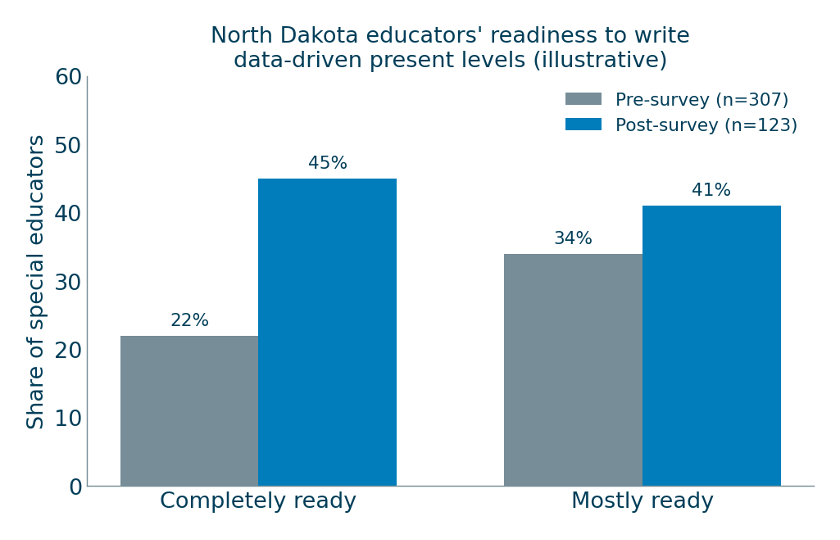
Source note: Data derived from Qualitative Findings of Goalbook Toolkit Educator Survey, JHU, 2025 (Pre-survey n=307, Post-survey n=123).
From Research To Practice: Implications for Leadership, Teaching, and Learning
Special educators face systemic challenges aligning IEP goals and choosing effective interventions, which erodes professional self-efficacy. Implementing Goalbook Toolkit mitigates these barriers — scaling mentorship and building a culture of collaboration through shared, standards-aligned frameworks. The result is a shift from hesitation to mastery: educators deliver more precise, data-driven instruction that supports both student outcomes and long-term retention.
