
Executive Summary
This San Francisco State University case study examined how Goalbook Toolkit affects the quality of the IEP learning goals that special-education teachers write. Dr. Susan J. Courey and Dr. Phyllis M. Tappe — training student teachers to write personalized, standards-aligned goals under the newly adopted Common Core — developed a research-based rubric scoring each goal on ten essential components (a 20-point scale) and compared goals written with and without Goalbook Toolkit. The difference was dramatic: goals written with Goalbook Toolkit averaged 17.5 versus 5.0 without, containing 2.5 times more information for planning and measuring a student’s success, and including 88% of the essential components versus 25%. The researchers concluded that supports suggesting ideas for dealing with ability gaps significantly improved student teachers’ ability to differentiate instruction for all learners. As an early, small case study, it demonstrates a strong rationale — and it is the origin of the “2.5× more information” finding cited across later Goalbook research.
The Methodology
The researchers built a research-based rubric to evaluate IEP goal quality, awarding points for the essential components of a well-written goal. A goal scored points if it: (1) was based on the student’s present level of performance; (2) included the student’s name; (3) illustrated what the student would be able to do; (4) specified the level or degree of performance; (5) gave the conditions under which the student would perform; (6) specified the length of time for mastery; (7) measured the student’s progress; (8) aligned to Common Core State Standards; (9) was adapted to the student’s individual needs; and (10) could reasonably be reached within one year. They then scored the goals their student teachers wrote — with and without Goalbook Toolkit as a resource — on the resulting 20-point scale and compared average scores and the share of essential components present.
Findings
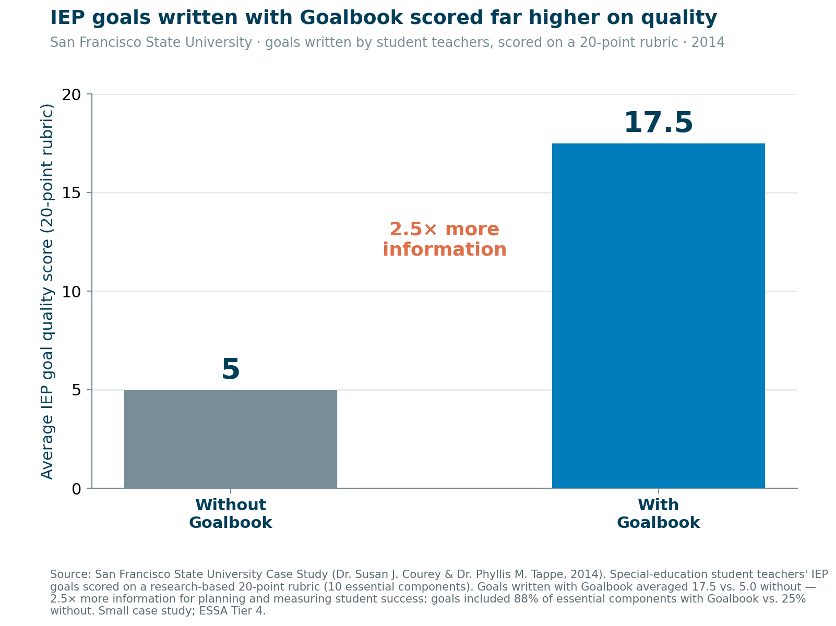
Source: SFSU Case Study (Courey & Tappe, 2014).
From Research To Practice: Implications for Leadership, Teaching, and Learning
A decade before the portfolio’s most recent studies, this case study named the mechanism the later research keeps confirming: better tools produce better IEP goals, and better goals are the foundation of specially designed instruction. The finding is especially relevant for teacher preparation and induction — the student teachers here were learning to write goals under Common Core, and Goalbook Toolkit gave them a scaffold to include the components that make a goal measurable, standards-aligned, and differentiated. For leaders, the implication is to introduce these supports early, when educators are forming their practice, so that writing a complete, high-quality goal becomes the norm rather than the exception. This 2014 result is also the historical anchor of the “2.5× more information” statistic that appears throughout Goalbook’s later research and communications.
