
When we talk about special education, we tend to picture the special education teacher. But a student’s IEP is delivered by a much wider team — speech-language pathologists, occupational and physical therapists, school psychologists, adapted physical education teachers, and specialists for students who are deaf or hard of hearing or who are blind or visually impaired. These related service providers (RSPs) are essential to the “specially designed instruction” the IEP promises. They are also, too often, the most isolated professionals in the building.
The reasons are structural. Many RSPs are itinerant, splitting a week across several campuses and never quite belonging to any one of them. Their expertise is specialized enough that general education teachers may not know what to ask for, and their schedules rarely align with the classroom teachers who see their students every day. The result is a quiet coordination gap: a therapist works on a skill in a pull-out session, a classroom teacher works on something else, and the two never quite connect. For the student, the Golden Thread frays not because anyone lacks skill or care, but because the team cannot easily share a common language or a common resource.
This is the gap a 2018 study by WestEd set out to examine — and it is a gap where Goalbook research points to a real, if under-discussed, contribution.
A study built around collaboration
WestEd designed a qualitative feasibility study to look specifically at how Goalbook Toolkit could affect collaboration and instructional practice for related service providers. Rather than test a large sample, the study went deep on one of the most specialized RSP relationships: Deaf and Hard of Hearing (DHH) specialists working alongside their general education counterparts. Eleven educators across California participated — five DHH specialists and six general education teachers — working in pairs (with one specialist supporting two teachers) over a four-week period. Data came from pre- and post-surveys and from Goalbook usage logs.
The research questions were pointed and practical: What is the nature and frequency of collaboration when educators use Goalbook Toolkit? What is its quality? Does using the resources change how specialists and general education teachers view working together on shared students? What barriers exist, and what additional supports would help? These are the questions a special education director actually asks when weighing whether a tool will change day-to-day practice rather than just sit on a shelf.
To support the study, Goalbook had recently published 300 new instructional content pages aimed squarely at related services — 102 for adapted physical education, 94 for blind and visual impairment, 69 for deaf and hard of hearing, and 35 additional teaching-strategy pages — on top of the Toolkit’s existing library spanning reading, writing, math, speech, behavior and social-emotional learning, autism, occupational therapy, alternate academic and life skills, and transition, from Pre-K through grade 12.
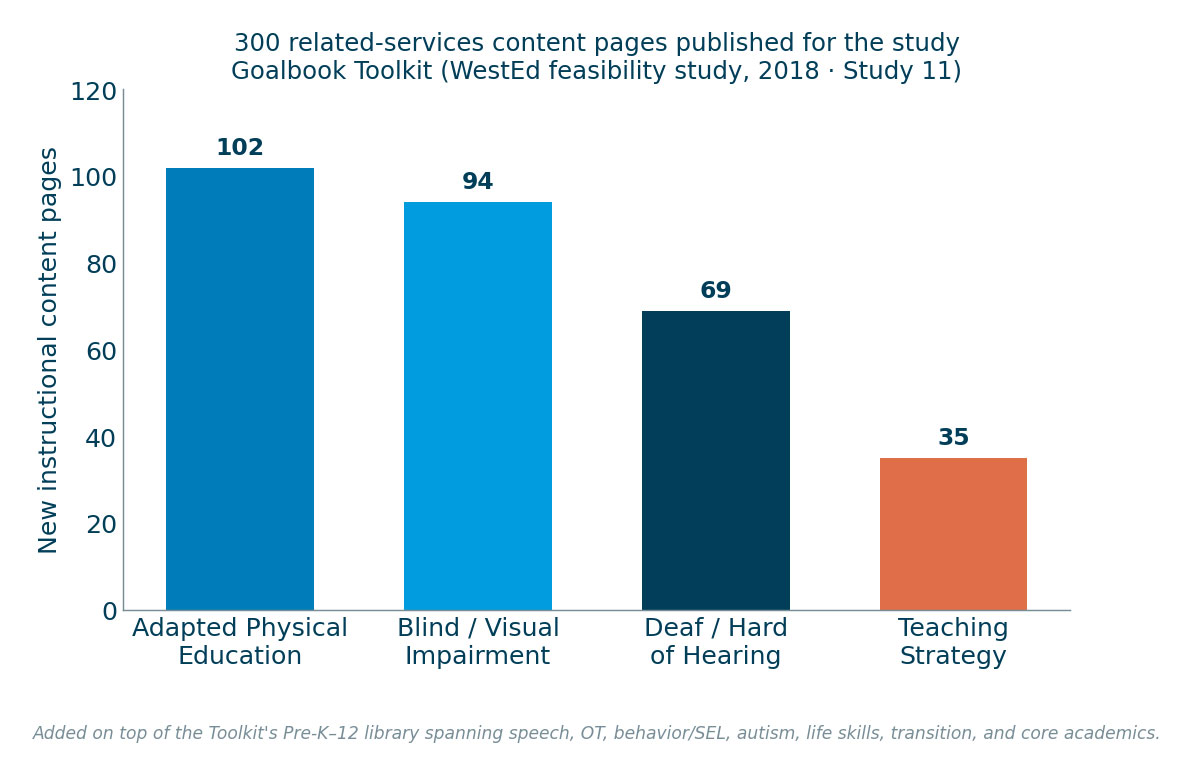
Goalbook Toolkit related-services content library published for the WestEd study
Chart: Bar chart of the 300 new related-services instructional content pages Goalbook published for the study: 102 adapted physical education, 94 blind/visual impairment, 69 deaf/hard of hearing, and 35 teaching-strategy pages.
Source note: Source: WestEd Related Service Providers Feasibility Study, 2018 (Study 11).
What the study found
In a short window, the study found that Goalbook Toolkit helped related service providers and general education teachers collaborate more effectively — and that the collaboration translated into more coordinated support for students. Three threads run through the educators’ own accounts.
It bridged distance. The itinerant reality of RSP work means that the informal, walk-down-the-hall exchange is often impossible. One specialist described the difference plainly: on site, sharing a resource is a short walk; off site, it means arranging a substitute and scheduling time away. Being able to share Goalbook resources across sites was, in the specialist’s words, exactly “where the benefit is.” The Toolkit gave a dispersed team an asynchronous common ground.
It made general education instruction more inclusive. General education teachers reported that working with their specialist through shared Goalbook resources streamlined their teaching and, notably, made their instruction more accessible to all their students — not only the ones with IEPs. One teacher described trying out a jointly planned lesson the next day and watching the whole class grasp it. Several made a version of the same observation: the strategies were not narrowly “for DHH students,” but broadly useful across the classroom. This is the promise of Universal Design for Learning realized through collaboration — a specialist’s expertise, made legible and usable to a general educator, lifts instruction for everyone.
It deepened the professional conversation. When general education teachers could see and understand a student’s goals, they could bring sharper observations back to the specialist — noticing a specific struggle in class and raising it, rather than deferring entirely to the pull-out session. A shared resource turned a one-directional handoff into a genuine dialogue between equals.
The collaboration effect is not unique to related services
If the WestEd study shows the collaboration mechanism up close in one specialized relationship, a much larger and more recent study suggests the same dynamic operates across the special education team generally. In the 2025 North Dakota statewide study, Johns Hopkins researchers found that implementing Goalbook Toolkit was associated with a stronger culture of collaboration among special educators: more than half reported that most or all of their colleagues were enthusiastic about collaborating on instruction, and roughly two-thirds felt their instructional expertise was more valued by their peers while using the Toolkit. Educators specifically credited the Toolkit’s “consistent format” with easing student transitions between buildings and across districts — keeping the instructional team aligned even as students moved.
That consistency is the connective tissue. When a therapist, a special education teacher, and a general education teacher are all working from the same standards-aligned framework and a shared vocabulary of goals and strategies, alignment stops depending on whether their schedules happen to overlap. The tool carries the coherence that proximity used to require.
Why this matters — and why few tools address it
Related service providers are frequently an afterthought in education technology. Most tools are built for the classroom teacher; the specialist is left to adapt something that was never designed for their role. Goalbook’s related-services content library and the collaboration findings position it differently — as a resource that treats the whole IEP team as its user, not just the special education teacher. For a district that has invested in reducing silos and building genuinely collaborative, inclusive practice, that breadth is a meaningful and rarely matched differentiator.
A necessary caveat: the WestEd study is a small-scale, qualitative feasibility study, and it should be read as such. It establishes plausibility and mechanism — that the resources can facilitate authentic collaboration in real settings — rather than a large-sample causal estimate. Its value is in showing, in educators’ own words, how the collaboration works and why it helps.
What this means for leaders
For special education leaders, the practical takeaways are concrete. Extend Goalbook Toolkit access deliberately to related service providers — the SLPs, OTs, PTs, and specialists who are easiest to overlook in a rollout — since the shared-resource benefit only materializes when the whole team is on the platform. Use the Toolkit as the common language between itinerant specialists and the general education teachers who see their students daily, so that coordination no longer hinges on being in the same building at the same time. And frame RSP collaboration as an inclusion strategy: the North Dakota consistency finding and the WestEd “helpful for all my students” finding both point to instruction that improves for the whole class when a specialist’s expertise becomes usable by the general educator.
The special education teacher is the center of the IEP team, but never the whole of it. The evidence suggests that when Goalbook Toolkit reaches the wider team — and gives its most isolated members a way to share expertise across the distances that usually separate them — collaboration improves, and students feel the difference.
