
Executive Summary
This impact study, conducted with DC Public Schools in 2016, examined how the Universal Design for Learning (UDL) framework — applied through instructional coaching and Goalbook Toolkit — affects teachers’ ability to differentiate instruction. Over four months, three instructional coaches were trained in UDL and, in turn, coached ten teachers through a structured cycle: co-planning a lesson focused on one student with an upcoming IEP, using Goalbook Toolkit to build UDL-aligned plans, observing the lesson against a UDL rubric, and conferencing afterward. Teachers’ ability to differentiate rose on a 0–3 scale — from 1.7 to 2.4 by their own rating and from 1.9 to 2.6 as observed by coaches — and every one of the ten teachers improved. Coaches also grew (their ability to coach differentiation rose from 2.1 to 3.0), and teachers reported stronger planning across all three UDL principles. All 13 participants said Goalbook Toolkit strongly supported their ability to learn and integrate UDL. As a small, qualitative study, it demonstrates a rationale for pairing Goalbook Toolkit with structured UDL coaching rather than establishing causal impact on student outcomes.
The Methodology
Researchers designed a four-month study in a large urban district around two questions: what impact the UDL framework has on classroom practice, and how districts can support teachers’ use of UDL. Three instructional coaches first completed a one-day UDL professional development workshop and learned to use UDL-aligned planning and observation documents within their coaching cycles. Each coach then delivered training to their teachers and met individually with each teacher to co-plan an upcoming lesson — focused on one student with an upcoming IEP — using Goalbook Toolkit to enhance UDL-aligned planning. Coaches observed each lesson, rated its quality on a UDL-aligned rubric created for the study, and conferenced afterward to reflect on the lesson and student work. Data came from the rubric evaluations plus pre/post surveys of both teachers and coaches, analyzed together to gauge growth.
Findings
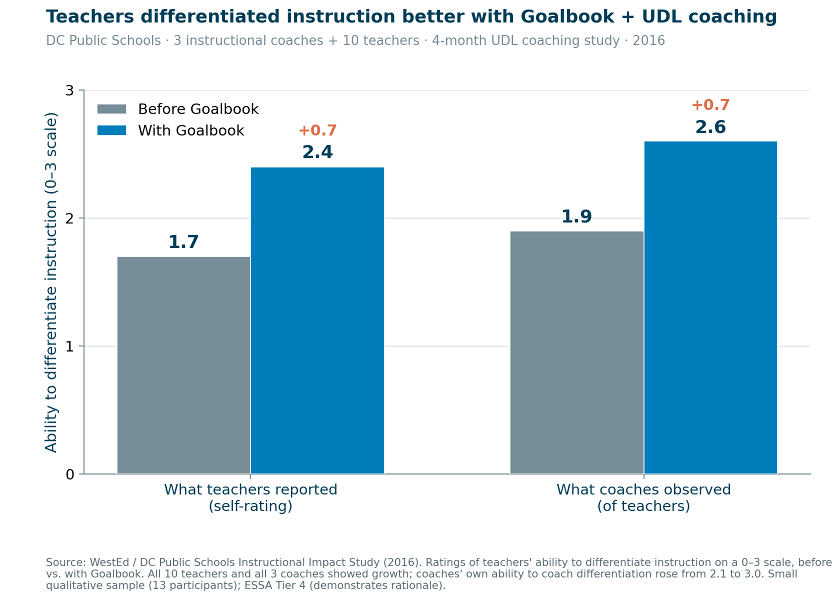
Source: WestEd / DC Public Schools Instructional Impact Study, 2016.
From Research To Practice: Implications for Leadership, Teaching, and Learning
This study is a blueprint for how to roll out UDL, not just a case that it works. The gains showed up because Goalbook Toolkit was embedded in a structured coaching cycle — group training, one-on-one co-planning, rubric-based observation, and reflection — rather than handed to teachers as a stand-alone resource. The pattern that teachers and their coaches improved suggests the model builds capacity at two levels at once, which is what makes it sustainable after the study ends.
For district leaders, the takeaway is concrete: Provide structured support and train everyone on the UDL tools (a UDL-aligned rubric plus Goalbook), and give coaches the same practice with the rubric that they’ll ask of teachers. That combination is what moved differentiation from “sometimes one strategy per lesson” to multiple means of representation, expression, and engagement.
