
Executive Summary
This SERVE Center (UNC-Greensboro) study examined the impact of Goalbook Toolkit on outcomes for students with special needs across North Carolina. Using a quasi-experimental event-study design built to meet What Works Clearinghouse standards and the ESSA Moderate Evidence (Tier 2) bar, researchers compared students with special needs in schools and districts that adopted Goalbook Toolkit with similar students in matched comparison districts — more than 58,000 students in all, drawing on statewide administrative data.
In Year 2 of implementation, students with special needs in schools implementing Goalbook Toolkit scored statistically significantly higher on the state reading assessment (effect size 0.08 SD, p ≤ .001), and that positive reading impact held across every examined student group.
Students in schools implementing Goalbook Toolkit were also significantly more likely to be placed in a regular education setting (72.5% vs. 69.7%). Greater school-level usage was associated with higher reading scores, and gains were larger in Year 2 than Year 1 — evidence that impact grows as implementation matures.
The Methodology
Researchers obtained statewide student records from the North Carolina Education Research Data Center (special education classification, demographics, setting, absences, and test scores) beginning in 2011–12. They defined treatment students as special education students eligible for services in the first year of their district’s or school’s Goalbook Toolkit adoption, and built a comparison group from districts matched on size, poverty, minority enrollment, and special education population. Baseline equivalence was established (all differences < 0.20 SD, within the 0.25 SD federal guideline). An event-study model with fixed effects for students, schools, and years estimated impacts on placement, assessment participation, reading and math scores, and absences, with parallel estimates for eight subgroups and a usage analysis tied to teacher-days of Goalbook Toolkit log-ins.
Findings
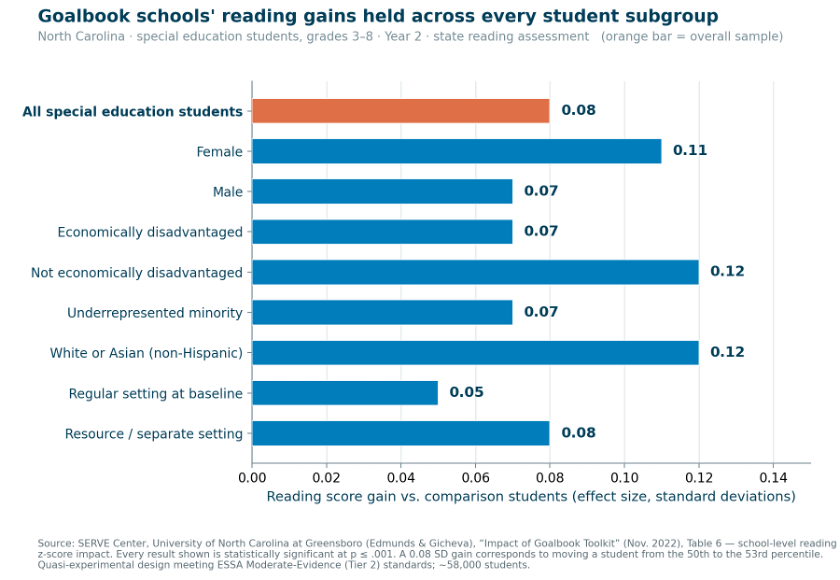
Source note: Data from SERVE Center / UNC-Greensboro, 2022, Table 6. A 0.08 SD gain ≈ moving a student from the 50th to the 53rd percentile.
From Research To Practice: Implications for Leadership, Teaching, and Learning
For North Carolina leaders, this is state-specific evidence that maps directly onto SPP/APR priorities. It speaks to Indicator 3a (reading proficiency): students with special needs in schools implementing Goalbook Toolkit posted statistically significant reading gains over comparison peers, and the gains held across every student group — an equity signal for closing achievement gaps.
It also speaks to Indicator 5a (least restrictive environment / inclusion): 72.5% of students with special needs in schools implementing Goalbook Toolkit were placed in general education settings versus 69.7% in comparison schools. Because Goalbook Toolkit impact grew from Year 1 to Year 2, the practical guidance is to pair implementation of Goalbook Toolkit with time and targeted professional development so districts can align SIMR action steps — high-quality IEP goals and Specially Designed Instruction rooted in the Science of Reading — to the outcomes they are accountable for.
