Executive Summary
This independent evaluation examined how special educators in Evergreen Public Schools (Vancouver, Washington) experience Goalbook Toolkit — what they find valuable, how they use it, and where they want more support. Conducted in 2020 by external evaluators from Washington State University–Vancouver and the University of New Mexico and later published in the AASEP journal, the study paired a short online survey (N = 19) with two focus-group interviews (n = 6). Educators reported strong satisfaction: 76% were very or extremely satisfied with the Goalbook Toolkit overall and 70% for IEP and specially designed instruction, with none very dissatisfied. Participants valued Goalbook Toolkit most for goal writing — the alignment of IEP goals to state standards, the wizard-guided assistance, and the ease of adapting a wide range of standards-aligned goals to individual learners. The clearest improvement request was for more professional learning and collegial dialogue about using the Goalbook Toolkit. As a qualitative Tier 4 study with a small sample, findings describe educator perceptions and a rationale for impact rather than causal effects on student outcomes.
The Methodology
The evaluation used a two-pronged, mixed-methods design. First, a short online survey was distributed to Evergreen special education personnel, capturing school type, role, frequency and purpose of Goalbook Toolkit use, satisfaction across several dimensions (four-point Likert items), and open-ended comments; the survey reached acceptable reliability (Cronbach’s α = 0.88, item means 3.4–4.2). Survey respondents were then invited to two semi-structured focus-group interviews (three participants each), which were thematically coded through an iterative process — mapping notes to research questions, using participants’ verbatim keywords, and reviewing a within- and cross-participant matrix to surface themes and subthemes
Findings
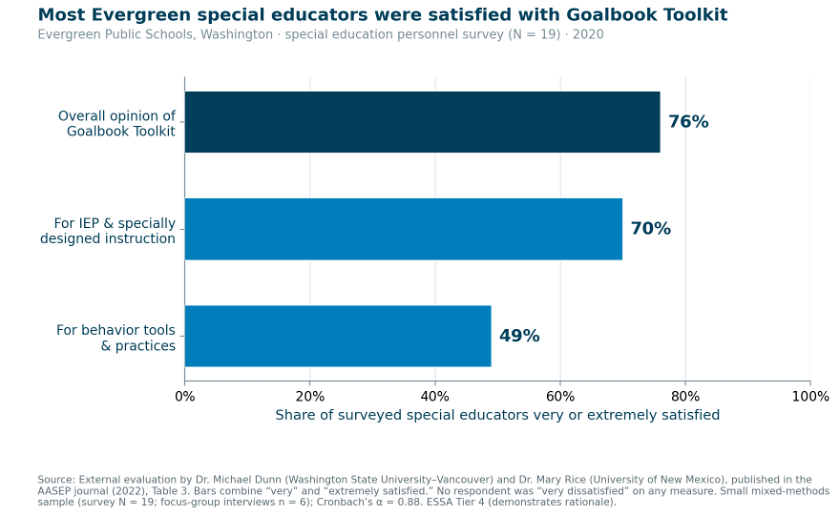
Source note: AASEP report (Dunn & Rice, 2022), Table 3; “very” + “extremely satisfied” combined; no respondent was “very dissatisfied.” Small mixed-methods sample
From Research To Practice: Implications for Leadership, Teaching, and Learning
This evaluation is the voice-of-the-educator complement to the outcome studies elsewhere in the portfolio: it shows why teachers reach for Goalbook Toolkit and where it fits their workflow. The consistent theme is goal writing — educators trust Goalbook Toolkit to connect state standards, present levels, UDL strategies, and anchor goals, and to make high-quality, adaptable IEP goals fast. The equally consistent request is for more professional learning, which points to a clear leadership move: pair Goalbook Toolkit access with sustained professional development and collaborative time adoption deepens beyond goal writing into behavior supports and everyday instructional planning. For a district, this is the kind of formative, qualitative evidence that guides implementation — surfacing what’s working and precisely what to invest in next.
