Executive Summary
This WestEd feasibility study examined whether Goalbook Toolkit could help related service providers and general educators collaborate more effectively in an authentic school setting. Over four weeks, five Deaf/Hard-of-Hearing (DHH) specialists and six general education teachers in California — working in pairs that shared at least one DHH student — used Goalbook Toolkit and reported on their experience through pre/post surveys, weekly logs, and interviews. Participants collaborated more frequently over the study, with specialists using Goalbook Toolkit to share DHH-specific strategies and to prepare, review, and revise IEP goals.
Goalbook Toolkit proved usable and quick to learn: 9 of 11 educators found it “easy to use,” 82% were comfortable or expert navigating it by Week 4, and 73% rated their overall experience above average or excellent. Teachers valued the ability to share resources quickly and apply DHH strategies with all their students, while the most common barriers were initial unfamiliarity and competing time demands. As a small, qualitative study, it demonstrates feasibility and rationale rather than causal impact.
The Methodology
WestEd designed a four-week feasibility study around five guiding research questions covering the nature and frequency of collaboration, the quality of that collaboration, and changes in educator attitudes, plus barriers and needed supports.
Participants worked in specialist–teacher pairs sharing at least one DHH student. A pre-survey captured background and the existing collaborative relationship; weekly logs (about five minutes each) tracked Goalbook Toolkit use and comfort; a post-survey re-asked the collaboration questions and added items on usability, satisfaction, and impact; and post-study interviews probed the survey and log responses.
Data were analyzed with descriptive summaries (e.g., Figures 1–3) and thematic coding of open responses and interviews. Participants also had access to ~300 newly published related-services content pages (Deaf/Hard-of-Hearing, Adapted Physical Education, Blind/Visual Impairment, and teaching-strategy pages).
Findings
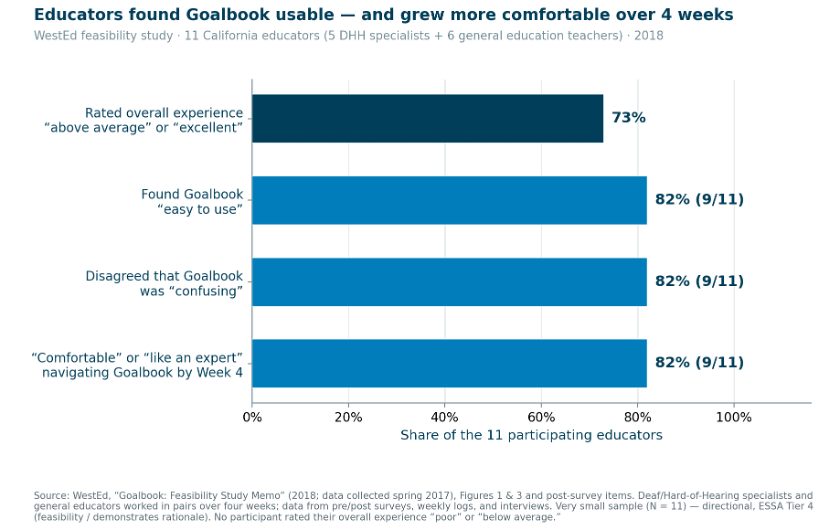
Source: WestEd Feasibility Study Memo, 2018.
From Research To Practice: Implications for Leadership, Teaching, and Learning
Related service providers — DHH specialists, SLPs, OTs, PTs, and others — often work across many sites and struggle to collaborate with the classroom teachers who serve their students day to day. This study shows Goalbook Toolkit can lower that barrier: it gave pairs a shared language and a fast way to exchange standards-aligned strategies, and specialists pulled Goalbook Toolkit content directly into IEPs. The comfort curve is the practical takeaway — usability climbed sharply over just four weeks, and Goalbook professional development resolved any friction of early unfamiliarity. For leaders deploying Goalbook Toolkit with related-service teams, the implication is to front-load onboarding, protect a little shared planning time, and introduce Goalbook Toolkit at the start of the school year so it supports the full IEP-development-and-monitoring cycle.
