Executive Summary
This University of Missouri study examined whether the quality of IEP present levels (PLAAFP) predicts the quality of annual IEP goals, and whether educators’ Goalbook Toolkit usage relates to student growth. It drew on standards-based IEPs from Special School District of St. Louis County, which has invested in standards-based IEP practice since 2015.
Using correlation and hierarchical multiple regression, researchers found a moderate-to-strong positive relationship between present-level quality and goal quality — present levels explained roughly 40% of the variance in goal quality (r = .63).
Educator experience and degree predicted 9.1% of the variance in student growth; adding Goalbook Toolkit usage explained an additional 2.2%. Findings echo a 2021 study linking PLAAFP quality to reading and math achievement.
The Methodology
Researchers scored 236 IEP goals and their matching present-level (PLAAFP) statements from 135 special educators serving 160 students (grades 2–8) at Special School District of St. Louis County, using a validated eight-item goal-quality rubric and a companion PLAAFP rubric (inter-rater agreement ~76–82%).
Pearson correlations tested the PLAAFP–goal relationship and the goal-quality–student-growth relationship; two hierarchical multiple regressions tested whether educator characteristics (experience, degree) and then Goalbook Toolkit usage (days active, meaningful events) predicted student growth. Results are situated alongside a 2021 study linking PLAAFP quality to reading and math achievement.
Findings
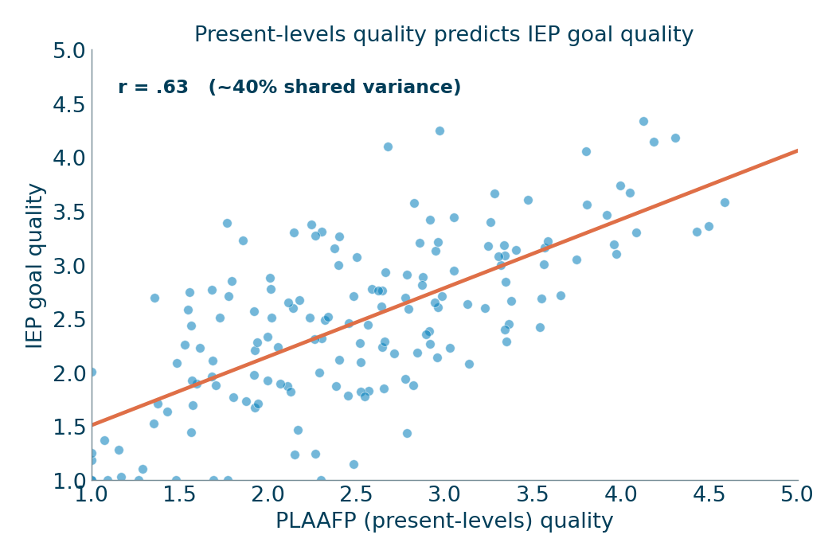
Source note: Data derived from University of Missouri IEP Goal Quality Technical Report, 2025 (N = 236 goals; 135 educators; 160 students).
From Research To Practice: Implications for Leadership, Teaching, and Learning
The strongest, most defensible lever for better IEP goals is better present levels. Because ~40% of goal quality traces back to PLAAFP quality, leaders should treat PLAAFP writing as a diagnostic skill — training educators to effectively analyze and synthesize data into a clear picture of the student’s strengths and areas of need. Goalbook Toolkit provides educators with a structured framework to develop coherent, high-quality IEPs, leading to more effective specially designed instruction.
