
Executive Summary
This Empirical Education study evaluated whether special educators’ Goalbook Toolkit usage was associated with students’ literacy outcomes in Prince George’s County Public Schools — the nation’s 18th-largest district — using 2021–22 data.
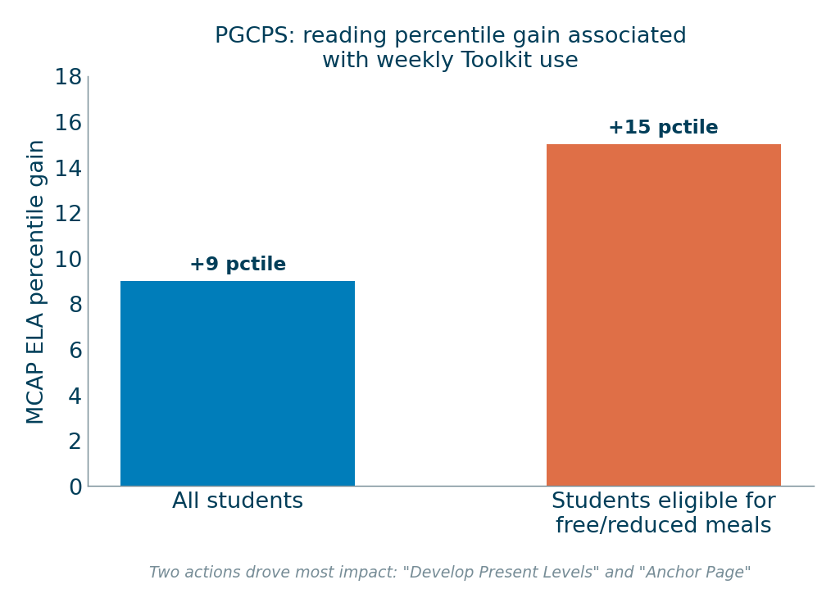
Applying correlational and comparison-group analyses to 4,378 student records, researchers linked Toolkit usage to performance on the Maryland Comprehensive Assessment Program (MCAP) English/Language Arts test. Consistent weekly usage was associated with a 9-percentile gain for the average student and a 15-percentile gain for students eligible for free and reduced meals.
While the overall comparison-group difference was not significant, students whose teachers used Goalbook Toolkit at least weekly outperformed those whose teachers used it less. Two specific actions — developing present levels and viewing anchor pages — accounted for much of the predictive power.
The Methodology
Correlational and comparison-group analyses of the relationship between educators’ Goalbook Toolkit usage and student literacy, using 2021–22 data from Prince George’s County Public Schools. The dataset covered 4,378 student records — demographics, school and teacher identifiers, pre- and post-test English/Language Arts scores, and multiple Toolkit-usage metrics. Outcomes were measured on the Maryland Comprehensive Assessment Program (MCAP) ELA test, and analyses isolated which usage behaviors most strongly predicted gains. Effects emerged among students whose educators used Goalbook Toolkit at least weekly.
Findings
Source note: Data derived from Empirical Education, Goalbook Toolkit in PGCPS, 2024 (N = 4,378 student records; 2021–22).
From Research To Practice: Implications for Leadership, Teaching, and Learning
The equity signal is the headline: the largest gains showed up for economically disadvantaged students, making consistent Goalbook Toolkit use a positive lever for closing gaps rather than widening them. Because two specific behaviors — developing present levels and using anchor pages — carried most of the predictive weight, professional development can target them directly. For a district organized around IEP-quality “Big Rocks,” the study validates the investment in Goalbook Toolkit while pointing to where coaching time pays off most.
