Executive Summary
This University of Missouri study examined the relationships among present levels quality, Goalbook Toolkit usage, and student achievement in reading and math for special education students in the Special School District (SSD) of St. Louis County, Missouri. Working with 211 special education teachers — all Goalbook Toolkit users — and one corresponding student each across 23 districts, researchers scored the quality of each teacher’s present levels statement (PLAAFP) on a rubric built and validated for the study, measured Goalbook Toolkit usage as a “Use Score,” and linked both to fall-to-winter growth on STAR and FastBridge reading and math assessments. Present levels quality was a statistically significant predictor of achievement in both subjects.
Goalbook Toolkit usage was positively associated with higher-quality present levels — high-usage educators wrote higher-quality present levels 20% more often than minimal-usage educators. And usage tracked with student growth: students of high-usage teachers grew 3.4× more in reading and 5.64× more in math than students of minimal-usage teachers. The study meets the ESSA Tier 3 evidence standard.
The Methodology
Researchers selected one Goalbook-written IEP (from 2018–19) per participating teacher and scored the quality of its present levels statement using a rubric created and validated for the study. Teachers’ Goalbook Toolkit usage was quantified as a “Use Score” — reflecting the type and frequency of resources accessed to create or implement strategies from the present levels statement — and grouped into three tiers: High, Above Average, and Minimal. Student achievement was measured via Renaissance STAR Reading/Math or FastBridge Adaptive Reading/Math, administered in fall and winter of 2019–20 as part of SSD’s usual seasonal screening. Correlational analyses tested (a) whether present levels quality predicted winter reading and math scores after accounting for school and achievement level, and (b) whether the Use Score predicted present levels quality and student growth.
Findings
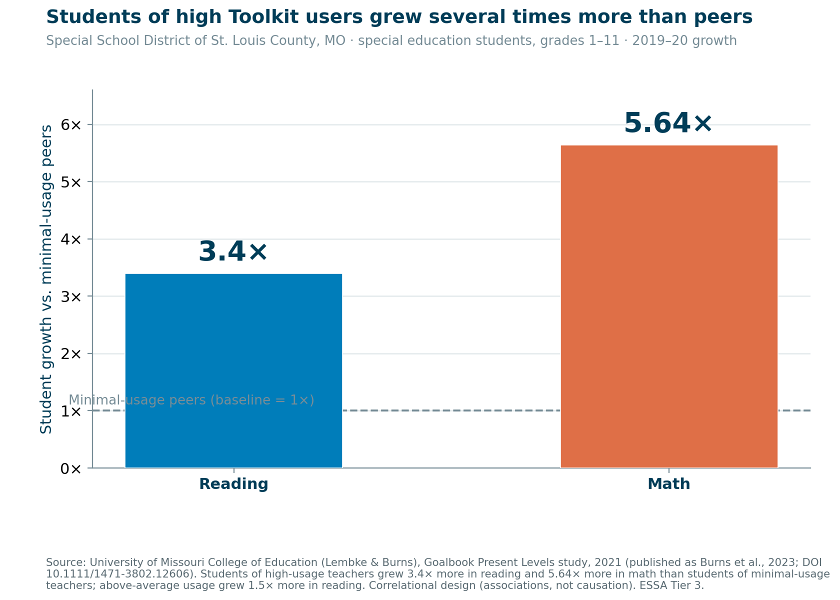
Source note: University of Missouri (Lembke & Burns) Present Levels study, 2021 (Burns et al., 2023). Above-average usage was linked to 1.5× more reading growth than minimal.
From Research To Practice: Implications for Leadership, Teaching, and Learning
This study puts a number on a long-held belief in special education: The present levels statement is the heart of the IEP. When present levels quality predicts achievement, and Goalbook Toolkit usage predicts present levels quality, leaders have a concrete lever — invest in the quality of present levels writing, and give teachers a structured tool to get there. The dose-response pattern (minimal → above-average → high usage tracking with progressively larger student growth) suggests the payoff grows with sustained, increased Goalbook Toolkit usage rather than occasional usage. Practically, that means treating present levels as a diagnostic skill to be coached, embedding Goalbook Toolkit into professional development, and monitoring Goalbook Toolkit usage as an early signal of where IEP quality — and student growth — can improve.
