Executive Summary
This impact study examined whether special educators’ use of Goalbook Toolkit was associated with stronger reading achievement for their students with IEPs. It is the first Goalbook impact study to look across multiple states at once — Michigan, North Carolina, and Ohio — drawing on 2,104 students, 270 educators, and 68 schools in the National Heritage Academies charter network during 2022–23, the third year of full Goalbook Toolkit implementation.
Using multiple regression with three-level hierarchical modeling and adjusting for prior achievement and student and educator characteristics, researchers found an overall positive relationship between Goalbook Toolkit usage and reading growth. Among educators in the 2nd–4th-quartiles of Toolkit usage, their students scored 2–3 points higher on MAP Growth than comparison students whose educators were in the lowest Toolkit usage quartile. The effect was strongest and statistically significant in Ohio — with a 0.30 effect size on both the MAP Growth and state reading assessments.
The Methodology
Researchers analyzed 2022–23 reading data for special education students in three states of one large charter network. Two academic outcomes were used: NWEA MAP Growth RIT reading scores (spring 2023, with fall 2022 as pre-test) and the relevant state assessment (Michigan M-STEP, North Carolina EOG, Ohio OST; standardized within state).
Educators’ Goalbook Toolkit usage was analyzed as part of the impact study; the primary “regular use” threshold was at least weekly (≈ 36+ events/year), with supplementary measures for any usage, median-or-above, meaningful event count, and Toolkit usage quartiles. Because 42% of the outcome variation clustered within educators, models used three-level HLM (students → educators → schools), adjusting for gender, socioeconomic status, ELL status, race/ethnicity, grade level, SPED setting, prior achievement, and educator experience and certification. Treatment and comparison groups were baseline-equivalent (standardized mean differences of −0.10 and −0.11, well below the 0.25 cutoff).
Findings
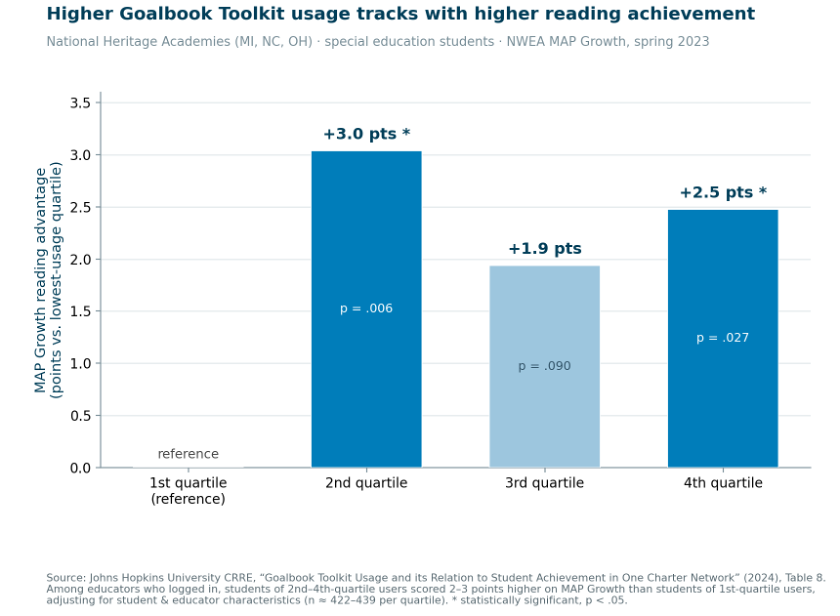
Source: Johns Hopkins University CRRE, 2024, Table 8.
From Research To Practice: Implications for Leadership, Teaching, and Learning
The signal here is a Goalbook Toolkit usage story: Increased student outcomes were associated with educators’ consistent use of Goalbook Toolkit. The Ohio outcome is the clearest illustration: where many educators had not yet adopted Goalbook Toolkit, the contrast between consistent Goalbook Toolkit users and non-users was sharp and significant. For multi-state networks, that argues for driving depth of adoption — embedding Goalbook Toolkit into educator practice to transform instructional practice as part of a sustained, supported, system-wide change effort.
