
Any single impact study can be explained away. A skeptic can always point to something specific about one district, one year, or one assessment. The question that matters is not “did it work once?” but “does it work again, somewhere else, measured by someone else?” On the relationship between Goalbook Toolkit usage and student reading achievement, the answer is increasingly clear. Four independent research teams, studying four very different settings, using different assessments and analytic methods, have all found the same thing. When special educators use Goalbook Toolkit — and especially when they use it consistently — their students read better.
This is what a body of evidence looks like. Not one dramatic result, but a pattern that holds across contexts that have almost nothing in common except the resource in the middle of them.
Four Settings, One Finding
Prince George’s County Public Schools (2024). In the nation’s 18th-largest district, an independent evaluation of 4,378 student records linked weekly Toolkit use to a 9-percentile gain on the Maryland MCAP English/Language Arts assessment for the average student — the equivalent of moving from the 50th to the 59th percentile. For students eligible for free and reduced meals, the associated gain was 15 percentiles. Two specific behaviors — developing present levels and viewing anchor pages — carried nearly as much predictive power as all Goalbook Toolkit usage combined.
A large Texas district (2024). Researchers studied academic outcomes from 3,787 students with special needs, served by 153 educators across 47 schools, during 2022–23. Using multilevel models that accounted for students nested within classrooms and schools, they found that students in mainstream placements whose educators used Goalbook Toolkit weekly scored about 1.9 points higher on the spring MAP Growth reading assessment. On the Texas STAAR reading test, any Goalbook Toolkit usage versus none was associated with a 2.9-point advantage. The more educators used Goalbook Toolkit, the larger the gains — students of educators in the top three Toolkit usage quartiles outscored the lowest quartile by 1.8 to 2.1 points.
A multi-state charter network (2024). The National Heritage Academies study was the first to look across multiple states at once — Michigan, North Carolina, and Ohio — covering 2,104 students, 270 educators, and 68 schools. Using three-level hierarchical modeling, researchers found that students of educators in the 2nd through 4th quartiles of Goalbook Toolkit usage scored 2 to 3 points higher on MAP Growth than students of educators within the lowest Toolkit usage quartile. The effect was sharpest in Ohio, where regular weekly use was associated with an effect size of 0.30 on both the MAP Growth and the Ohio state reading assessment.
North Carolina, statewide (2022). The largest of the four in scope, this ESSA-aligned study examined more than 58,000 special education students across North Carolina, comparing schools whose educators had access to Goalbook Toolkit against matched schools that did not. Third- through eighth-grade students in Goalbook Toolkit schools achieved statistically significantly higher reading scores, with an effect size of 0.08 standard deviations. Two details stand out: 1) The gains held across every subgroup examined — gender, race, ethnicity, and socioeconomic status; and 2) the gains grew over time, with Year 2 outperforming Year 1. More Goalbook Toolkit usage played a role as well, with an additional 30 teacher-days of Toolkit usage corresponding to a further 0.03-standard-deviation increase in reading outcomes.
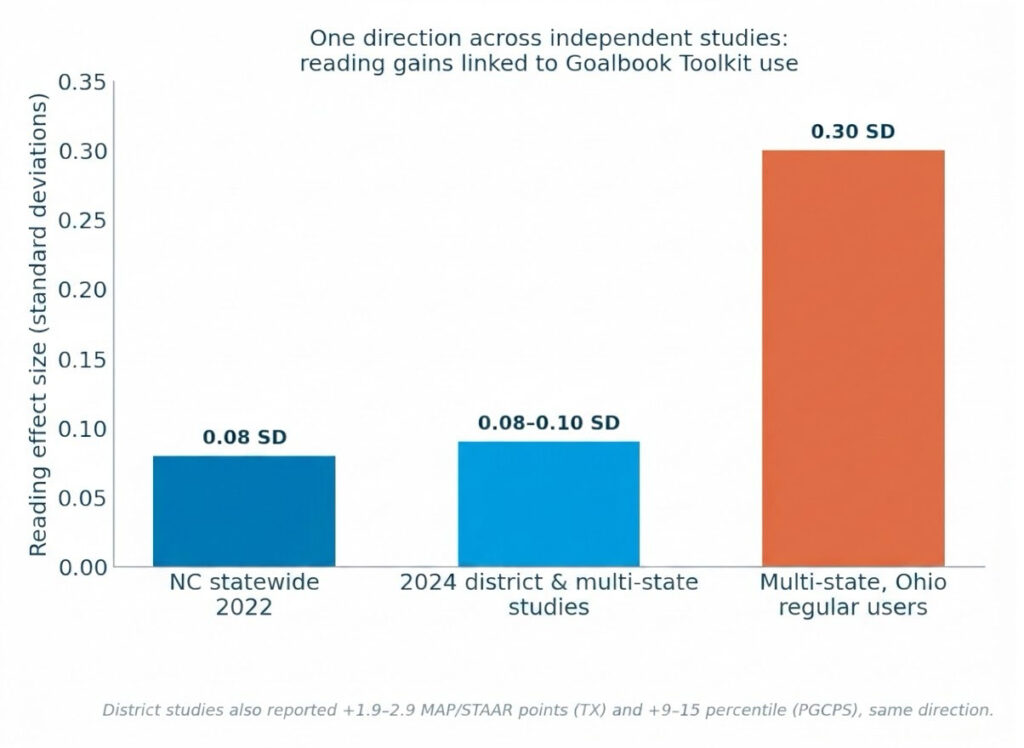
Reading effect sizes associated with Goalbook Toolkit use across independent studies
Why the Consistency Matters More Than the Size
A reading of these numbers acknowledges that the effect sizes are moderate — generally in the 0.08 to 0.10 range across the 2022–2024 studies, rising to 0.30 where the contrast between Goalbook Toolkit users and non-users was cleanest. It would be easy to look at “0.08 standard deviations” and shrug. That would be a mistake, for two reasons.
First, in education research, effects of this kind are meaningful. A 0.08-standard-deviation gain applied across 58,000 students is not a rounding error; it is a measurable shift in the reading trajectory of tens of thousands of children who are, by definition, the students for whom academic progress is hardest to move. When PGCPS translates that into “the 50th to the 59th percentile,” the practical stakes come into focus.
Second, and more importantly, the power of this evidence is not in any one number. It is in the convergence. These four studies differ in almost every way an impact study can differ. Different states and district types, from a single Texas district to a statewide North Carolina sample to a three-state charter network. Different assessments: MAP Growth, STAAR, MCAP, North Carolina’s EOG, Ohio’s OST. Different analytic approaches, from multilevel modeling to matched-comparison quasi-experiments. When results consistently emerge from designs this varied, the most parsimonious explanation is that the positive relationship exists. Method-specific flukes do not replicate across methods.
The Mechanism Is Not a Mystery
How do Goalbook Toolkit usage and improved IEP quality move reading scores? The impact studies themselves suggest the pathway. Goalbook Toolkit supports educators in writing clearer, more actionable IEPs, which means literacy instruction is more precisely tailored to each student’s needs. Goalbook Toolkit puts a library of evidence-based, science-of-reading-aligned strategies at educators’ fingertips. Goalbook Toolkit supports measurable goals and progress monitoring, which makes instruction more responsive. In addition, a companion body of Goalbook impact research on educator efficacy demonstrates that Goalbook Toolkit usage increases educators’ confidence in their ability to teach reading well. Better plans, better strategies, better monitoring, and more confident educators are not four different explanations. They are four facets of the same instructional improvement.
What This Means for Leaders
For leaders weighing a Goalbook Toolkit investment or renewal, the strategic takeaway is that this is no longer a question of whether a single pilot happened to succeed. The reading-achievement finding has been replicated independently, across states, assessments, and methods, over multiple years. That is precisely the kind of solid evidence that supports a confident systemic investment rather than a cautious experiment.
Two practical notes. First, consistency of Goalbook Toolkit usage is an active ingredient. The strongest impact study results consistently appeared where educators use Goalbook Toolkit consistently or in higher usage quartiles, so implementation plans should make regular, consistent Goalbook Toolkit usage the norm rather than treating access as the finish line. Second, impact compounds. The North Carolina impact study’s Year-2-over-Year-1 pattern is a reminder that the returns on a Goalbook Toolkit instructional investment grow as educator practice matures. The evidence rewards patience and follow-through, and it now carries real weight.
