Executive Summary
This impact study examined whether special educators’ Goalbook Toolkit usage was associated with their students’ reading growth in one large Texas district during 2022–23. Using multilevel models that accounted for students nested within classrooms and schools, researchers compared students whose educators used Goalbook Toolkit weekly to those whose educators used it less often, drawing on NWEA MAP Growth and Texas STAAR reading assessments.
Regular Toolkit usage was associated with significantly higher achievement for key subgroups: students in mainstream placements scored about 1.9 points higher on spring MAP, and any usage versus none was linked to 2.9 points higher on STAAR. Higher Toolkit usage quartiles corresponded to larger gains. Results suggest consistent Toolkit use supports reading achievement, particularly for mainstreamed students.
The Methodology
Correlational study analyzing the relationship between educators’ Goalbook Toolkit usage and students’ one-year reading growth, using multilevel modeling to account for students clustered within classrooms and schools. The primary usage measure was weekly engagement with Toolkit resources; researchers also examined interaction frequency, any-versus-no usage, and usage quartiles.
Reading achievement was measured with NWEA MAP Growth (Fall 2022–Spring 2023) and Texas STAAR (Spring 2022–Spring 2023). Models controlled for student demographics, prior achievement, special education placement, and educator experience and certification. Sample: 3,787 students with special needs, 153 educators, across 47 schools.
Findings
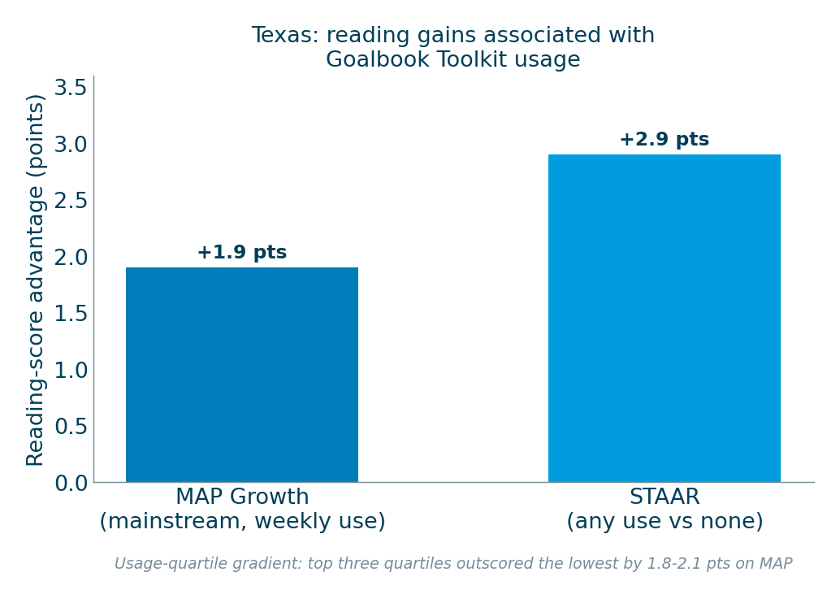
Source note: Data derived from JHU/CRRE Texas Impact Study, 2024 (N = 3,787 students; 153 educators; 47 schools; 2022–23).
From Research To Practice: Implications for Leadership, Teaching, and Learning
Consistency is the active ingredient: the strongest results appeared where educators used the Toolkit weekly, and even minimal use outperformed none on the state test. Because gains were most pronounced for the majority-mainstreamed students, leaders can position Goalbook Toolkit as support for inclusive, UDL-aligned instruction — not just compliance. The practical move is to build routines and expectations that make weekly Toolkit use the norm across special educators and related service providers.
