Executive Summary
This impact study examined how special educators use Goalbook Toolkit and how Goalbook Toolkit usage relates to special educators’ attitudes and beliefs — specifically their self-efficacy for special education instructional design, job satisfaction, and intentions to stay in their positions and in the field. Drawing on Goalbook Toolkit usage data for 54,387 educators and three self-report surveys across 2022–23, researchers found that educators reported meaningfully higher confidence at year’s end.
Self-efficacy for instructional design rose from 6.94 to 7.59 on a 10-point scale; among educators with scores at both time points, the gain (6.79 → 7.51) was statistically significant with a medium effect size. Confidence in using Goalbook Toolkit itself climbed from 4.46 to 6.71.
More than 95% of educators agreed Goalbook Toolkit supported core IEP practices, job satisfaction averaged 2.31 of 3, and most intended to remain in education. Educators in the top quartile of Goalbook Toolkit usage showed significantly more self-efficacy growth than those in the lowest-usage quartile — a signal that deeper use of Goalbook Toolkit may support growing educator confidence.
The Methodology
This descriptive evaluation combined Goalbook Toolkit usage records with three surveys: a pre-training survey (given to educators in districts typically in their first or second implementation year), an annual mid-year user survey (distributed to all active Goalbook Toolkit account holders), and an end-of-year survey (given to Goalbook-training respondents).
Self-efficacy was measured with Goalbook’s Self-Efficacy for Special Education Instructional Design Scale — adapted from the Tschannen-Moran & Woolfolk-Hoy Teacher Sense of Efficacy Scale and validated by JHU CRRE in 2022 (KR-20 ≈ .80). Analyses summarized Goalbook Toolkit usage patterns and survey responses and tested whether usage related to self-efficacy (before training, end-of-year, and growth), job satisfaction, and retention intentions, including comparisons across Goalbook Toolkit usage quartiles.
Findings
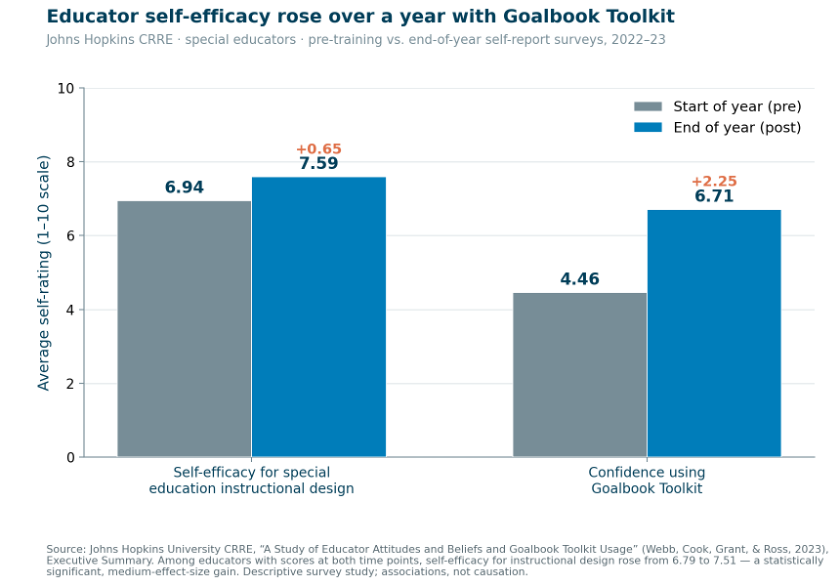
Source note: Data from Johns Hopkins University CRRE, 2023, Executive Summary; matched-pair instructional-design gain (6.79 → 7.51) was statistically significant with a medium effect size.
From Research To Practice: Implications for Leadership, Teaching, and Learning
Self-efficacy is not a soft metric — decades of research tie a teacher’s belief in their own effectiveness to instructional quality, job satisfaction, and staying in the profession. This study shows that a year of Goalbook Toolkit use coincided with rising confidence, and that the educators who used Goalbook Toolkit most – grew the most. Notably, highest early Goalbook Toolkit usage tended to come from educators who started with lower confidence, suggesting Goalbook Toolkit is especially valuable as scaffolding for those who need it. For special education leaders, the practical move is to pair Goalbook Toolkit with induction, coaching, and time to build fluency — treating educator confidence-building as a lever for both instructional quality and retention.
