
There is a version of educational technology that quietly widens gaps. It reaches the students who were already well served — the ones with engaged support at home, the ones in the least restrictive settings, the ones for whom the system already mostly works — and leaves everyone else roughly where they started. When a district serving a high proportion of students in poverty, students of color, and students with disabilities considers a new instructional investment, the fair and hard question is not just “does it raise the average?” It is “who does it raise, and does it narrow the distance between them?”
Goalbook impact research offers an encouraging answer. Across multiple independent impact studies, the gains associated with Goalbook Toolkit usage were not concentrated among already-advantaged students. In several cases, they were largest for the students who are typically underserved. The equity signal is not a footnote to the outcomes story — it may be the most important part of it.
The Clearest Number: Prince George’s County Public Schools, MD
The most direct evidence comes from Prince George’s County Public Schools (MD), the nation’s 18th-largest district. An independent Goalbook impact study consisted of 4,378 student records in 2021–22. PGCPS is a district defined by diversity: roughly half of students identify as Black or African American, a growing share as Hispanic or Latino, and about 62% are eligible for free or reduced-price meals.
For the average student, weekly Goalbook Toolkit usage by their educator was associated with a 9-percentile gain on the Maryland MCAP English/Language Arts assessment. For students eligible for free and reduced meals, that associated gain was 15 percentiles — not a smaller effect for the more vulnerable group, but a substantially larger one. In a single result, the study inverts the usual worry about edtech and inequality. Goalbook Toolkit usage did its heaviest lifting precisely where the need was greatest.
That matters strategically. Districts organized around closing achievement gaps are constantly searching for levers that pull hardest for their most vulnerable students. The PGCPS finding identifies Goalbook Toolkit as a candidate for exactly that role.
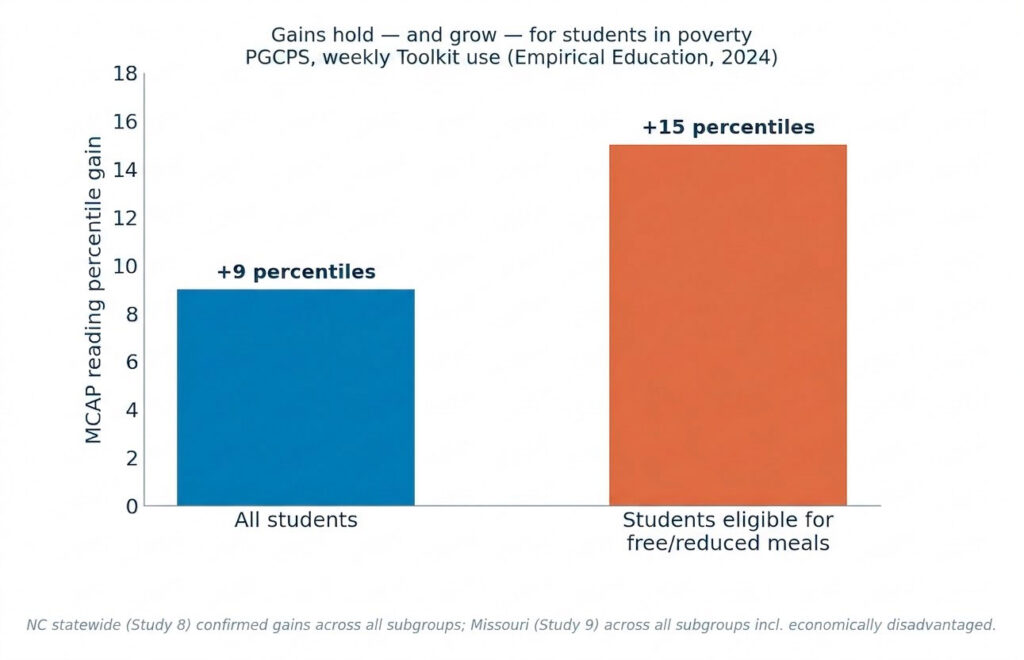
PGCPS reading percentile gain — All students vs. students in poverty
Source: Empirical Education, Goalbook Toolkit in PGCPS, 2024
A Pattern, Not a One-off
If PGCPS were the only place this showed up, it would be interesting but not conclusive. It is not the only place.
In a Texas district impact study (2024), the strongest reading results appeared for students with special needs in mainstream placements — who made up 65% of the sample in a district where 87% of students qualified for free or reduced lunch and half identified as Hispanic. The gains, in other words, concentrated among the mainstreamed, economically disadvantaged students at the heart of inclusive education.
In a North Carolina statewide study (2022), the equity story is stated even more plainly. Across more than 58,000 special education students, the reading gains associated with Goalbook Toolkit access held true for the overall sample and for every subgroup examined — by gender, race, ethnicity, and socioeconomic status. The benefit did not accrue to one demographic at the expense of another; it moved across the board. The same impact study surfaced a second equity dimension that is easy to overlook. In schools implementing Goalbook Toolkit, 72.5% of special education students were placed in general education settings, compared with 69.7% in comparison schools without Goalbook Toolkit access. Inclusive placement is itself a catalyst for academic growth, and Goalbook Toolkit was associated with more of it.
The pattern reaches back further still. The 2021 University of Missouri study found that the positive impact of Goalbook Toolkit usage on reading scores appeared across all subgroups examined, including economically disadvantaged students and students of different races and ethnicities. And the 2024 multi-state charter-network study drew on a demographically diverse population across three states, with treatment and comparison groups established as baseline-equivalent before the analysis began. Different researchers, different states, different years — and the same reassuring evidence.
Why Goalbook Toolkit Advances Equity
The mechanism is worth naming, because it explains why the equity effect is a feature rather than a coincidence. Students who are economically disadvantaged, who are learning English, or who carry the compounded weight of disability and poverty are the students for whom generic instruction fails most often and for whom precise, individualized, standards-aligned instruction matters most. Goalbook Toolkit provides educators with support in writing sharper present levels, setting a truly measurable goal, and selecting an evidence-based, science-of-reading-aligned strategy, which by its nature, is a resource that pays its largest dividends where instruction has the most ground to make up.
Goalbook Toolkit is built around individualization — the discipline of meeting each student where they are and designing forward from there. It should not be surprising that a tool for individualization helps most where individual needs are greatest. The impact research simply confirms what the design implies.
What This Means for Special Education Leaders
For leaders whose strategic plans center equity — closing gaps, improving outcomes for students in poverty, expanding meaningful inclusion — this body of evidence supports a specific decision. Targeting Goalbook Toolkit implementation toward the schools and educators serving the most vulnerable students is not a compromise on rigor; the data suggests it is where the return is highest.
Three implications follow.
- Prioritize consistent, weekly use in the settings serving disadvantaged students, since that is where the largest gains were observed.
- Pair Goalbook Toolkit access with the two Toolkit usage behaviors flagged as highest-impact — developing present levels and using anchor pages — through targeted professional learning.
- Connect Goalbook Toolkit usage to inclusion goals, given the North Carolina impact study finding that Goalbook Toolkit schools placed more students with disabilities in general education settings.
Educational tools are not neutral; they either narrow gaps or widen them. On the weight of the evidence, Goalbook Toolkit belongs in the first category — reaching hardest for the students the system has too often reached for last.
