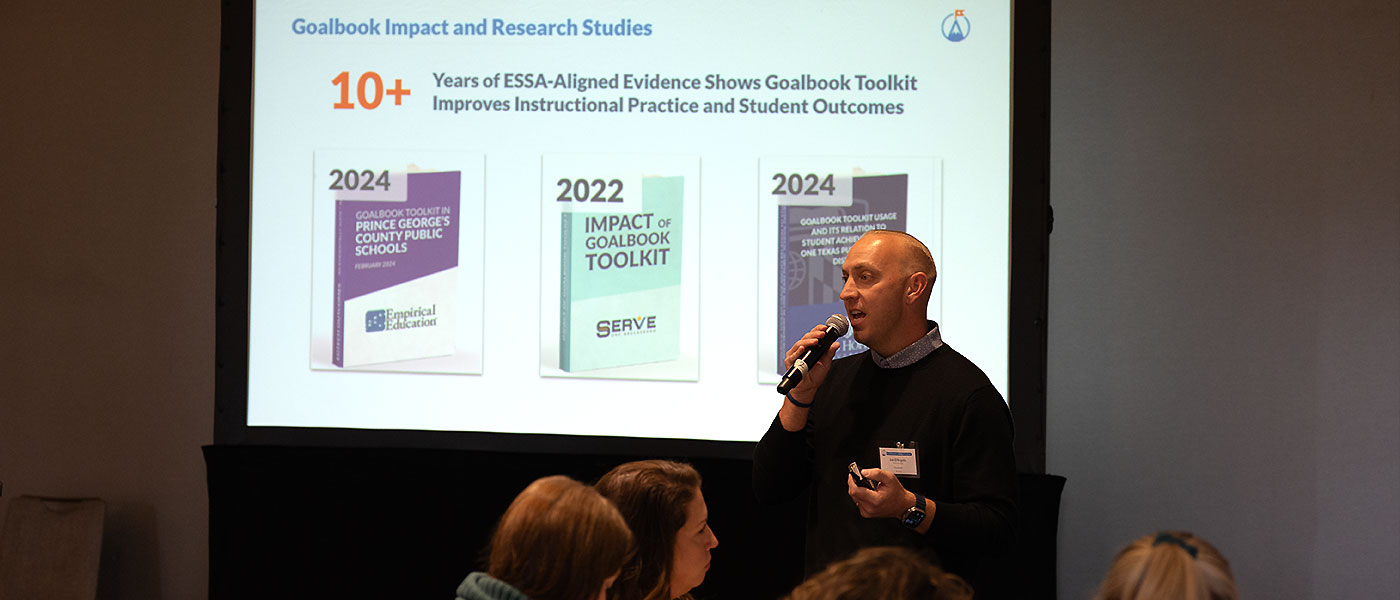

Most educational technology arrives with a testimonial and a hope. What distinguishes Goalbook is a decade of independent research — impact study after impact study, conducted not by Goalbook but by universities and third-party evaluators, examining whether Goalbook Toolkit changes educator practice and student outcomes. Each impact study aims to answer a specific question. Taken together, they tell a larger story: a consistent, accumulating, independently verified case that has grown broader and more rigorous with each passing year.
This is the through-line of Goalbook’s efficacy portfolio. No single impact study carries the argument. The argument is the pattern — a direction of evidence that has held for more than ten years, across seven independent research organizations, multiple states, and every level of the system from a single educator’s IEP goals to a statewide sample of tens of thousands of students.
Where It Began: Better Goals, Better Planning (2014–2016)
The story starts in 2014 at San Francisco State University, where researchers set out to empower educators to write more personalized learning goals. Using a research-based, 20-point rubric, researchers scored IEP goals written with and without Goalbook. The goals developed with Goalbook Toolkit averaged 17.5 out of 20; those written without it averaged 5.0. Put differently, goals written with Goalbook’s support contained about two and a half times more of the essential information needed to plan and measure a student’s progress — 88% of essential components present, versus 25% without. “We thought Goalbook would have a positive effect,” Dr. Tappe said, “but the results were phenomenal.”
Two years later, in 2016, WestEd studied the deeper question of instructional practice. In a four-month mixed-methods study in a large urban district, three instructional coaches and ten teachers used Goalbook Toolkit to plan Universal Design for Learning– aligned instruction and were rated on a UDL rubric before and after. Teachers’ ability to differentiate instruction improved measurably under the combination of training, coaching, and Goalbook Toolkit usage. The early evidence established the foundation: Goalbook supports educators in writing better goals and planning more effective instruction.
Broadening the Lens: Collaboration and Qualitative Depth (2018–2020)
By 2018, the Goalbook’s impact studies reached beyond the special education teacher to the wider instructional team. WestEd designed a qualitative study of related service providers — the speech therapists, occupational and physical therapists, and specialists who often work in isolation from classroom teachers. Focusing on Deaf and Hard of Hearing specialists and their general education counterparts across California, the study found that Goalbook Toolkit resources helped these providers and teachers collaborate more effectively in a short period of time, translating into more coordinated support for shared students.
In 2020, researchers from Washington State University–Vancouver and the University of New Mexico turned a qualitative lens on Evergreen Public Schools in Washington. Through surveys and focus groups, educators described where Goalbook Toolkit added the most value: the connection between state standards, UDL strategies, and anchor goals; intuitive help with goal writing; and the ease of adapting goals to specific learner needs. The message from these years was that Goalbook’s benefit extended across roles and was visible not only in scores but in how educators described their own practice.
Rigor and Scale: The Outcomes Era (2021–2024)
From 2021 onward, Goalbook’s impact research grew markedly more rigorous and larger in scale, moving decisively toward measured student outcomes.
The 2021 University of Missouri impact study, connected the pieces of the IEP to student learning: present-levels quality significantly predicted student achievement in reading and math across 211 teachers and 23 districts, and the students of educators with the highest Toolkit usage grew 3.4 times more in reading and 5.64 times more in math than students of educators with the lowest Toolkit usage.
The 2022 UNC-Greensboro SERVE Center impact study took the question statewide, examining more than 58,000 special education students across North Carolina. Students in schools using Goalbook Toolkit achieved statistically significantly higher reading scores — an effect that held across every subgroup and grew from Year 1 to Year 2 of Goalbook Toolkit implementation.
In 2023, impact shifted to the educator, showing that self-efficacy for special education instructional design rose over a year of Goalbook Toolkit use, from 6.94 to 7.59 on a ten-point scale – educators with the deepest Goalbook Toolkit usage growing the most.
Then, in 2024, three separate impact studies landed in a single year — a Texas district, Prince George’s County in Maryland, and a three-state charter network — each independently linking educators’ Goalbook Toolkit usage to stronger student reading, with the largest gains for consistent Toolkit users and for economically disadvantaged students. That three independent evaluations reached the same conclusion in the same year is itself part of the evidence.
The Newest Work: Tying it Together (2024–2025)
The most recent Goalbook impact studies close the loop between educator experience and student outcomes. The 2024 North Carolina educator retention study found that novice special educators in district with access to Goalbook Toolkit stayed at significantly higher rates — up 9.1 percentage points in-district. The 2025 North Dakota impact study traced rising confidence into stated intent to stay. And the 2025 University of Missouri goal-quality study established that present-levels quality explains roughly 40% of the variation in IEP goal quality — completing the “Golden Thread” from present levels to goals to student growth first glimpsed in the 2021 study.
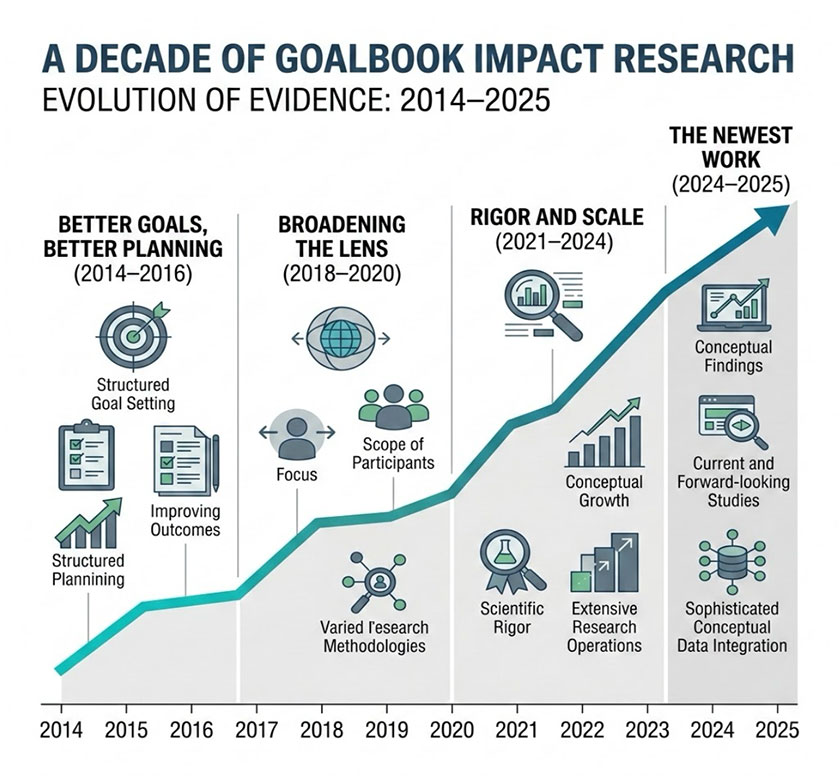
Source: Goalbook impact research portfolio, 2014–2025
Why Independence is the Point
It would be one thing for a company to publish its own favorable analyses. It is another for that pattern to emerge from independent research organizations. When their findings converge, the convergence carries greater weight.
The methodological range matters just as much. Goalbook’s efficacy portfolio spans qualitative focus groups, rubric-scored IEPs, correlational analyses, multilevel models, and quasi-experimental matched-comparison designs. Different methods have different blind spots; a finding that survives all of them is far more trustworthy than one propped up by a single approach. And the impact studies increasingly reference and build on one another — the 2025 Missouri study extends the 2021 one; the 2024 retention study follows the 2022 statewide student-impact work in the same state — so the body of impact research reads less like scattered data points and more like a cumulative program of inquiry.
Independent, Third-party Validation
The strongest word in “a decade of independent evidence” is independent. Goalbook did not grade its own homework; established external evaluators did — and in some studies, verification was the explicit purpose. The 2016 WestEd study in the District of Columbia Public Schools is a clear example: WestEd, a respected nonpartisan research agency, tested whether Goalbook-supported UDL coaching changed classroom practice, and found that all ten participating teachers grew in their ability to differentiate instruction, with self-rated differentiation rising from 1.7 to 2.4 on a four-point scale (and coaches rating the same teachers’ growth from 1.9 to 2.6). The 2020 Evergreen Public Schools study went further in kind: it was an external evaluation, conducted by university researchers at Washington State University–Vancouver and the University of New Mexico and published through the American Academy of Special Education Professionals, expressly to validate the district’s investment — and it did, documenting where educators found Goalbook Toolkit most valuable in their own words.
Across Goalbook’s efficacy portfolio, that independence is structural rather than occasional. Impact studies have been carried out by separate research organizations — none of them Goalbook — spanning universities, a federally connected research agency, and a commercial evaluation firm. No single institution’s methods, incentives, or blind spots shape the record.
For districts, this matters for a practical reason: rigorous external evaluation is expensive and rarely feasible locally. An existing base of independent, third-party validation is a resource a district can lean on without having to fund it — evidence generated and vouched for by evaluators with reputations of their own to protect.
What this Means for Leaders
For a decision-maker, the strategic value of a decade of independent evidence is confidence. External evaluation is expensive and rarely feasible at the local level, which is exactly why an existing, independent, and consistent research base is such an asset: it lets a district ground an investment or a renewal in evidence it did not have to generate itself. The portfolio answers the questions leaders ask — Does Goalbook Toolkit improve IEP quality? (yes, since 2014) Does Goalbook Toolkit transform instructional practice? (yes, since 2016) Does Goalbook Toolkit move student outcomes? (yes, and repeatedly since 2021) Does Goalbook Toolkit help retain teachers? (yes, in the newest work) — and it answers them with independent voices.
Ten years in, the picture is not a spike but a steadily rising line. The evidence has grown broader, more rigorous, and more consistent, and it continues to accumulate. For a field that has too little high-quality research and too many unproven products, that decade-long, independently verified track record is itself the headline.
