

Special educators talk about the “Golden Thread”, the coherence that should run through an IEP, connecting a student’s present levels of performance to their annual goals to the specially designed instruction they receive each day. When the thread is strong, everything downstream is aligned. When it frays — when present levels do not accurately diagnose student strengths or needs or the goal floats free of the baseline — instruction fragments and student growth stalls.
Of course, coherence matters. What has been missing is evidence. A traced, data-backed pathway showing that the pieces of the thread connect in the way we assume, and that improving one link measurably improves the next. Two impact studies from the University of Missouri, conducted four years apart by an overlapping research team in the same long-committed district, supply exactly that. Together, these two impact studies follow the thread from end to end: Present-levels quality predicts student growth, present-levels quality predicts goal quality, and Goalbook Toolkit’s positive impact is evident in both studies.
The Setting: A Decade of Intentional Practice
Both impact studies were conducted in Special School District (SSD) of St. Louis County, Missouri. SSD launched a comprehensive standards-based IEP initiative in 2015 and has invested in professional learning and coaching ever since, methodically moving from goal quality to the finer craft of present-levels quality. That decade of intentionality created a rare environment where the quality of IEP components varied enough, and was documented well enough, to study rigorously. Here is a summary of findings across the studies.
Link one: Present Levels Predict Student Growth (2021)
The first study, led by the University of Missouri in 2021, collected data from 211 special education teachers across 23 districts, each paired with one of their students with special needs, spanning grades 1 through 11. Its questions were foundational. What is the relationship between present-levels quality and student achievement, after accounting for school and prior achievement? And how does Goalbook Toolkit usage affect present-levels quality?
The answers established the thread’s anchor point. Using a rubric designed and validated specifically for the impact study, researchers found that present-levels quality was a significant predictor of student achievement in both reading and math, even after factoring out school and achievement level. The present level, in other words, was not just paperwork; it carried real diagnostic and instructional weight.
Then came findings related to Goalbook Toolkit usage. Teachers were grouped into high, above average, and low usage tiers, and the pattern of Goalbook Toolkit usage was steep. The more teachers used Goalbook Toolkit, the higher the quality of their present levels and the greater their students’ growth in reading and math. In the cases where Goalbook Toolkit usage was highest, students grew 3.4 times more in reading and 5.64 times more in math than the students of teachers with the lowest Goalbook Toolkit usage. Goalbook Toolkit usage was associated with improved quality of present levels and increased student learning outcomes.
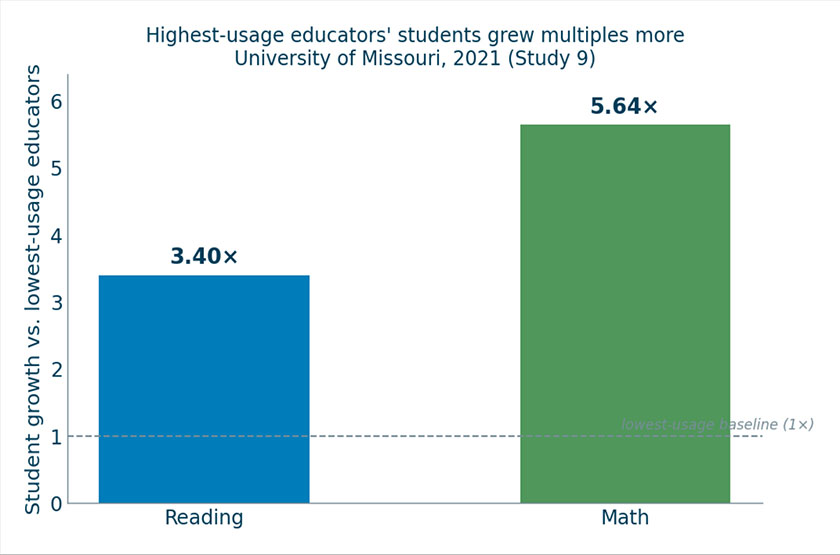
Source: University of Missouri Present Levels study, 2021 (Burns et al., 2023).
Link two: Present Levels Predict Goal Quality (2025)
If present-levels quality drives growth, the natural next question is: What drives goal quality at the other end of the thread? The 2025 University of Missouri study examined the link. Researchers scored 236 IEP goals and their matching present-level statements, written by 135 special educators serving 160 students, using validated rubrics.
The relationship was strong. Present-levels quality and IEP goal quality correlated at r = .63, meaning roughly 40% of the variation in goal quality could be explained by the quality of the present levels that preceded it. This is a striking figure for anyone who has tried to improve IEP goals directly and found the gains hard to hold. The 2025 study suggests why. The goal is downstream of the present level. A vague or thin present level cannot support a sharp, measurable goal, no matter how much attention the goal itself receives.
The same study examined what predicts student growth across a workforce ranging from novices to veterans. Educator characteristics, years of experience and degree level, predicted 9.1% of the variance in student growth. When Goalbook Toolkit usage was added to the model, it explained an additional 2.2%, above and beyond the educator demographics. That additional slice fell just short of the conventional threshold for statistical significance, and we report it as the trend it is. But its direction is consistent with everything else the thread reveals: Goalbook Toolkit functions as a force multiplier, giving educators a structured framework to produce aligned, high-quality IEPs regardless of where they sit on the experience curve.
The Thread Confirmed in Practice
The two Missouri studies establish the thread through careful rubric scoring. A third, independent impact study shows the same links operating in the reality of a large district’s Goalbook Toolkit implementation. In Prince George’s County Public Schools (MD), a 2024 analysis of 4,378 student records asked which specific Goalbook Toolkit behaviors most predicted student literacy gains. Two rose to the top: 1) Developing Present Levels and 2) Using Anchor Page. Together, these two Toolkit acctions accounted for nearly as much predictive power as all Goalbook Toolkit usage combined.
That is a remarkable convergence. The Missouri studies, using scored IEP documents, identify present-levels quality as the pivotal link in the thread. The PGCPS study, using educator behavior in Goalbook Toolkit across an entirely different district, independently identifies the act of developing present levels as the single most impactful thing educators do in Goalbook Toolkit. Two very different independent research lenses pointing to the same place in the IEP.
What This Means for Leaders
For a special education leader, the strategic implication reorders the usual improvement agenda. The most defensible lever for better IEP goals is not more training on goals — it is better present levels. Because roughly 40% of goal quality traces back to the present level, and because present-levels quality independently predicts student growth, the present level is where coaching time compounds. Three moves follow.
- Treat present-levels writing as a diagnostic skill, not a clerical one. Train educators to synthesize formal and informal data into a clear picture of where a student’s learning breaks down, so the goal that follows is both attainable and measurable.
- Shift professional learning from compliance to coherence, focusing explicitly on the link between the present level and the goal. If the area of need in the present level does not connect to the skill in the goal, instruction is likely to fragment.
- Standardize baselines, ensuring every goal has a baseline that matches its measurement method, so progress can be tracked and instruction adjusted.
The Golden Thread is no longer just a metaphor. Across two Missouri studies and one large-district evaluation, it is a traceable, evidence-backed pathway. Strengthen the present level, and you strengthen both the goal that depends on it and the student growth that follows from it.
