

It’s a fair question to ask of any instructional tool – Does using it actually move student outcomes? Adoption is easy to measure by the logins, clicks, features opened. Learning is harder. The gap between the two is where a lot of ed-tech promises quietly fall apart.
A 2024 study conducted by an independent university research center set out to close that gap for Goalbook Toolkit. Rather than ask whether a district had Goalbook, the researchers asked a sharper question: Among special educators who all had access, did the ones who used it more have students who grew more in reading? The answer, across three states, was yes — consistently, if modestly.
The Dosage Finding
The study followed 2,104 special education students, 270 educators, and 68 schools across the National Heritage Academies charter network in Michigan, North Carolina, and Ohio during 2022–23. Using multiple regression with three-level hierarchical modeling — students nested within educators nested within schools — and adjusting for prior achievement plus a long list of student and educator characteristics, the researchers compared reading growth against how much each educator used the Toolkit.
The relationship was positive. Among educators who logged in, students of higher-usage educators outscored students of the lowest-usage group on the NWEA MAP Growth reading assessment: +3.0 points for the second usage quartile (p = .006), +1.9 for the third (p = .090), and +2.5 for the fourth (p = .027). It’s a dosage story — the benefit showed up for educators who moved past a few exploratory clicks into sustained use.
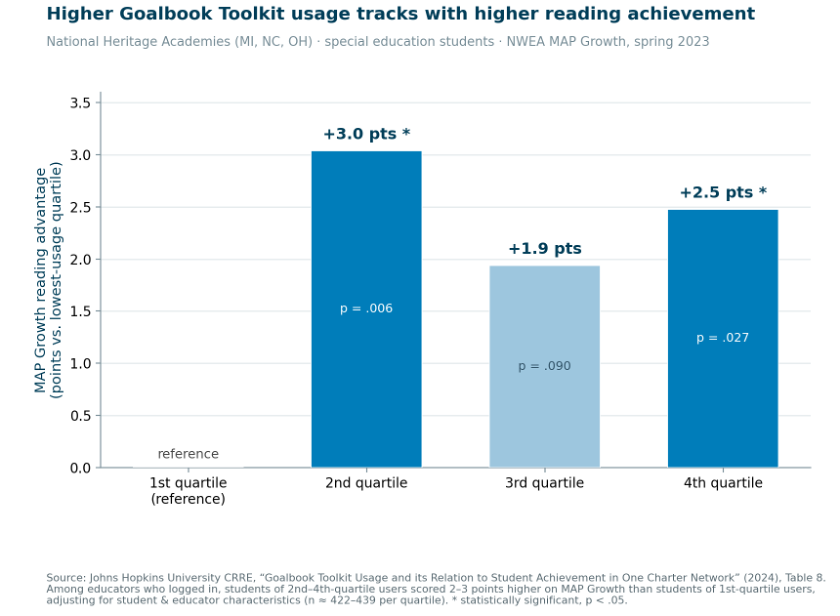
Source: Johns Hopkins University CRRE, 2024, Table 8.
The clearest illustration came from Ohio, where there was a sharp contrast between regular users of Goalbook Toolkit and non-users. There, regular weekly Goalbook use was tied to a 0.30 effect size on both outcomes: roughly +5.9 points on MAP Growth and +0.28 standard deviations (about 9.5 points) on the state reading test. The relationship between Goalbook Toolkit usage to student outcomes came at the three-year mark of full implementation, earlier than the five-plus years that previous Goalbook impact studies allowed. National Heritage Academies’ Goalbook impact study is best read as a promising, directionally positive signal.
Similar Pattern, Multiple Studies
When a modest finding lines up with stronger evidence pointing the same way, the modest finding gets more credible and the body of work gets harder to dismiss. Two other Goalbook impact studies with more rigorous designs tell the same Toolkit usage-to-student-outcomes story.
The strongest is a 2022 statewide analysis by the SERVE Center at UNC-Greensboro which examined reading outcomes for students of special educators using Goalbook Toolkit across North Carolina. The impact study found statistically significant reading benefits across student subgroups, with effect sizes from 0.05 to 0.12 standard deviations, all significant at p ≤ .001. The effects are not enormous, but they are consistent, significant, and drawn from a design built to isolate Goalbook Toolkit’s contribution across an entire state.
The second impact study by the University of Missouri in collaboration with Special School District of St. Louis County (MO), looked at the relationship between educators’ usage of Goalbook Toolkit and student outcomes in reading and math. Students whose educators were in the highest Toolkit-usage tier showed reading growth about 3.4 times higher than that of students with educators in the lowest Goalbook Toolkit usage tier. Students whose educators were in the highest Toolkit usage tier saw math growth 5.64 times higher than that of students with educators in the lowest Toolkit usage tier. That impact study also traced why. Increased usage of Goalbook Toolkit was associated with higher-quality IEP present levels, and present-levels quality was in turn a strong, significant predictor of student growth.
These three studies form a significant chain. Missouri shows the mechanism of more Goalbook Toolkit usage produces better present levels and stronger student growth. North Carolina shows Goalbook Toolkit impact holding up across an entire state under a rigorous design. National Heritage Academies shows the same positive directional pattern surfacing in a third context, across three states, even under demanding data conditions and at just three years in of their Goalbook Toolkit implementation.
Why Goalbook Toolkit Consistency and Integration Matter
The through-line is that Goalbook Toolkit works when it’s used and used well. That may sound obvious, but it reframes what leaders should watch. A login is not an outcome. The National Heritage Academies data makes the point almost literally. The students experiencing the greatest gains were the ones whose educators made Goalbook Toolkit part of their regular planning, not the ones whose educators had merely activated an account. In Ohio, with a large share of educators who hadn’t engaged in Goalbook Toolkit, the gap between student outcomes of Goalbook Toolkit users and non-users was at its widest.
That’s consistent with everything the deeper impact studies suggest about the mechanism. Goalbook Toolkit’s value shows up when educators use Toolkit to create sharper present levels, set measurable and standards-aligned goals, and plan the specially designed instruction those goals call for. Toolkit access makes that possible but sustained Toolkit use makes it happen.
What This Means for Leaders
For a district or network leader, the implication is practical. Measure and drive depth of adoption, not just rollout. The evidence rewards educators who move from occasional logins to weekly, embedded use. So the goal is to embed Goalbook Toolkit into educator practice, which argues for onboarding that builds real fluency, for protecting the planning time that lets educators use Goalbook Toolkit as intended, and for giving Goalbook Toolkit implementation a few years to take root before judging its impact. The National Heritage Academies study caught a positive signal at year three; the Missouri and North Carolina studies show what that signal becomes as implementation deepens.
No single impact study should settle the question. It’s the pattern across impact studies. Here, we see findings are steady and in a positive direction. Where special educators use Goalbook Toolkit consistently, their students tend to grow more in reading. For leaders deciding where to put their energy, that points less toward buying access and more toward building use.
